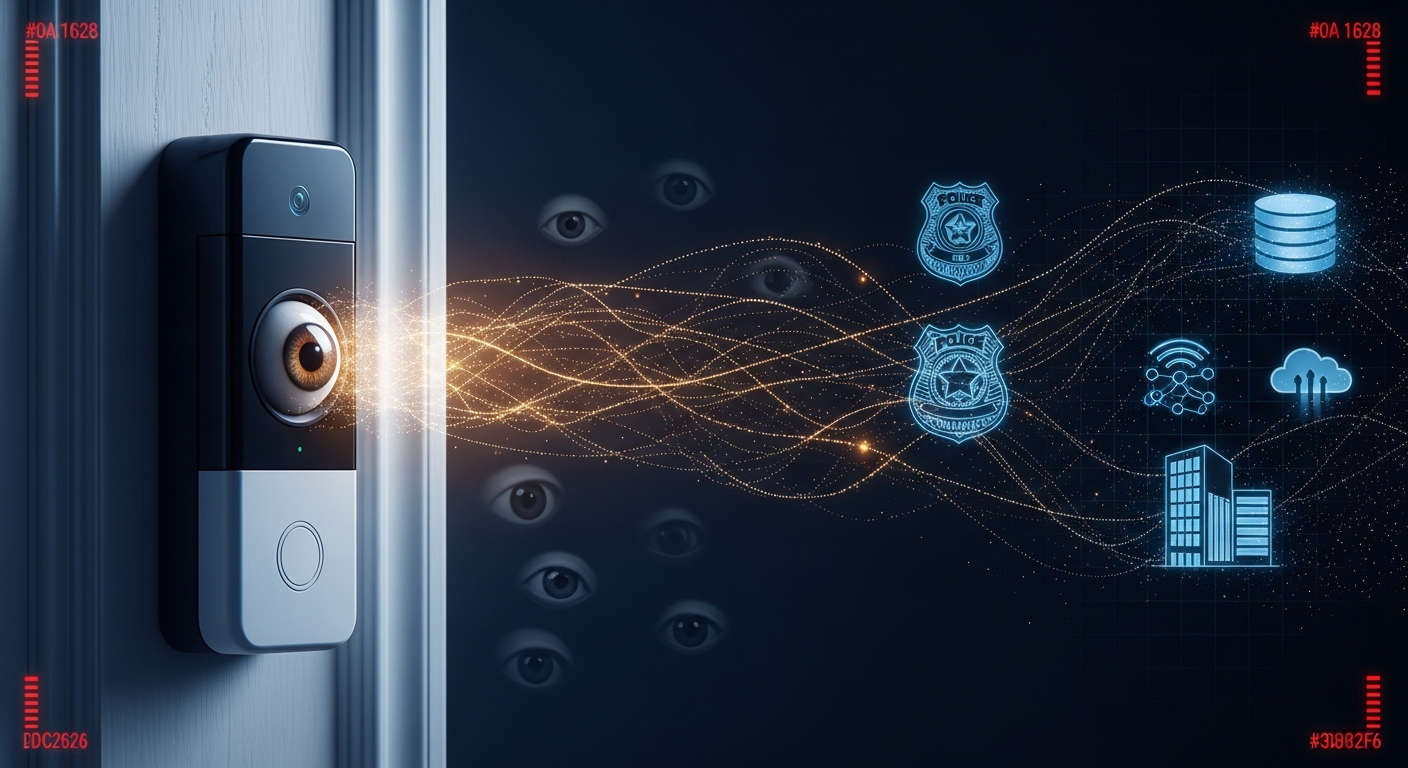
The camera protecting your front porch might be the biggest threat to your privacy inside your home.
Here’s a number that should keep you up at night: 87% of Americans have no idea how their doorbell camera data is being used.
That statistic, from The Zebra’s 2024 consumer survey, means the vast majority of the estimated 20+ million Ring doorbell owners in the United States are operating in the dark. They know their camera records video. They assume it’s stored somewhere secure. Beyond that? Complete blind spot.
But the companies behind these devices—Amazon’s Ring, Google’s Nest, Arlo, and others—know exactly what they’re collecting. And it goes far beyond that 30-second clip of your Amazon delivery driver leaving a package.
Just this month, the Electronic Frontier Foundation issued a stark warning about Ring’s latest features, calling them “a scary overreach of the surveillance state designed to catch us all in its net.” The privacy watchdog was responding to Ring’s AI-powered facial recognition features that transform millions of residential doorbell cameras into a distributed surveillance network—with homeowners as unwitting operators.
This isn’t paranoia. This is documented fact. And after spending weeks investigating the privacy practices of major smart camera manufacturers, what we found should make every homeowner reconsider the true cost of that $100 doorbell camera.
 Secure IoT HouseSecure IoT House
What Data Does Your Smart Doorbell Actually Collect?
When you install a Ring doorbell, you’re not just mounting a camera. You’re inviting Amazon into your life in ways the marketing materials don’t advertise.
According to Ring’s own privacy policy—the one most users never read—the company collects:
- Your name, phone number, email, and physical address
- Your age and gender
- The precise geolocation of your mobile device every time you open the app
- Every single doorbell press and app interaction
- All video and audio recordings (including conversations happening near your door)
- How many times your doorbell rings and when
- Movement patterns around your property
That last point is particularly invasive. Ring doesn’t just record when someone approaches your door. It builds a behavioral profile of everyone who enters your property—family members, friends, delivery workers, and random passersby.
But here’s where it gets worse: Ring shares this data with third parties you’d never expect.
Hidden Data Sharing with Facebook and Google
In 2020, the Electronic Frontier Foundation conducted a forensic analysis of Ring’s Android app and discovered something troubling. Ring was sharing user data with five separate companies—yet only one of those companies was disclosed in Ring’s privacy notice. The recipients? Facebook and Google, among others.
Mozilla’s Privacy Not Included guide—a consumer resource that evaluates smart devices for privacy violations—gives Ring cameras their dreaded “Privacy Not Included” warning label. That’s Mozilla’s polite way of saying: don’t buy this if you value your privacy.
The FTC’s $5.6 Million Ring Privacy Settlement
In 2023, the Federal Trade Commission had seen enough. The agency charged Ring with allowing any employee or contractor to access consumers’ private videos. Not select employees with clearance. Not trained security personnel. Any employee.
The FTC investigation revealed that Ring had given Ukraine-based third-party contractors “up-close-and-personal” access to customer video feeds. Employees and contractors could view, download, and transfer sensitive video footage for their own purposes—including footage from bedroom cameras and baby monitors.
Ring paid $5.6 million to settle the charges. More than 117,000 customers received refund payments in 2024. But the damage was already done. Years of private video footage—intimate moments inside customers’ homes—had been accessible to people who should never have seen them.
Google Nest and Arlo Privacy Concerns
If you thought switching to a different brand would solve the problem, think again.
Google’s Nest cameras feed directly into the company’s larger data ecosystem—the same infrastructure that powers targeted advertising across the web. Your front door video becomes another data point in Google’s comprehensive profile of your life.
Arlo has made public commitments to privacy, even issuing statements on International Data Privacy Day. But their cameras still rely on cloud storage, their retention policies still keep your footage for 30-60 days, and law enforcement can still subpoena that data whether you like it or not.
 Secure IoT HouseSecure IoT House
Ring Police Partnerships: Your Doorbell as a Surveillance Tool
This isn’t hyperbole. It’s documented fact.
In August 2019, Ring had partnerships with approximately 400 police departments across the United States. By the end of 2020, that number had exploded to over 2,000 departments. According to Ring’s own disclosures and reporting from WIRED and The Washington Post, more than 2,600 law enforcement agencies have had formal relationships with Ring—including over 170 departments in California alone.
How Police Access Ring Footage Without a Warrant
For years, Ring actively courted police departments through free camera giveaways. The quid pro quo was simple: Ring gets market penetration, police get access to a vast network of residential surveillance cameras without having to obtain warrants.
Through Ring’s “Request for Assistance” tool, police officers could directly request footage from Ring users. No warrant required. No judicial oversight. Just a notification on your phone asking if you’d like to “help” with an investigation.
In January 2024, Ring announced it would shut down this program—a move privacy advocates celebrated as a major victory. But that victory was short-lived.
In July 2025, Ring partnered with Axon—the company that makes police tasers and body cameras—to effectively reinstate the warrantless request system. Officers can now request footage directly through Axon’s evidence management platform, which surfaces the request to Ring users who can “voluntarily” share.
The infrastructure for warrantless police access is back. It just has a different name.
Three Ways Law Enforcement Gets Your Doorbell Footage
According to CNET’s analysis, law enforcement can obtain your doorbell footage through three primary channels:
- Emergency requests: No warrant required if police claim “imminent danger.” There’s no independent oversight of these claims.
- Warrants and subpoenas: Court-ordered access to cloud-stored video. Even footage you’ve “deleted” may still exist in company backups.
- Community requests: Officers publicly post requests asking for voluntary footage sharing. Social pressure does the rest.
Here’s what Ring won’t tell you: how many users have had their footage turned over to police. Unlike Apple, Google, and other tech giants that publish transparency reports, Amazon doesn’t break out the specific number of Ring users whose information was shared with law enforcement.
The Flock Safety License Plate Reader Integration
In October 2025, Ring deepened its surveillance integration by partnering with Flock Safety—a company that deploys AI-powered license plate readers used by police departments, federal law enforcement, and Immigration and Customs Enforcement (ICE).
Your doorbell camera is now part of a growing surveillance mesh that can track vehicles, identify faces, and build movement profiles across entire neighborhoods—all without your explicit consent.
The Eufy Security Camera Scandal: When “Privacy-Focused” Is a Lie
If the Ring revelations have you considering alternatives, here’s a cautionary tale about trusting any company’s marketing claims.
Eufy, a brand owned by Anker and marketed specifically as a privacy-focused alternative to Ring, built its entire reputation on local storage. No cloud. No subscriptions. Your footage stays on your device.
That was a lie.
In late 2022, security researchers discovered that Eufy cameras were uploading identifiable footage to the cloud without user consent—directly contradicting the company’s core marketing promise. Worse still, unencrypted video streams could be accessed remotely by anyone with basic technical knowledge.
As security researcher Paul Moore documented: video streams from Eufy cameras could be viewed through VLC media player with nothing more than the right URL—no authentication required.
Anker initially denied the allegations. Then deflected. Then went silent.
In February 2023—months after the scandal broke—Anker finally admitted the truth. Their cameras were not end-to-end encrypted as claimed. User images were being uploaded to cloud servers for “notification purposes.” The company’s privacy claims were, by their own admission, misleading.
A class action lawsuit followed. The lesson? “Privacy-focused” is a marketing term, not a guarantee. The only way to verify a company’s claims is independent security research—something most consumers can’t perform on their own.
 Secure IoT OfficeSecure IoT Office
Smart Camera Hacks: Baby Monitors and Bedroom Cameras at Risk
Privacy violations aren’t abstract concepts. They’re happening in real homes, to real families, right now.
In 2018, a Texas mother discovered someone had hacked into her family’s Nest camera—the one pointed at her infant son’s crib. A stranger’s voice came through the camera’s speaker, threatening to kidnap the baby. The incident was reported by NBC News and sparked national concern about IoT security.
This wasn’t an isolated incident. The FBI has investigated multiple cases of WiFi baby monitors “going rogue.” Hackers have used compromised cameras to speak directly to children. The UK’s National Cyber Security Centre has issued formal warnings about the risks of smart cameras and baby monitors.
In 2021, researchers at Mandiant discovered a devastating vulnerability in the Kalay IoT platform—a backend system used by millions of web cameras and baby monitors from multiple manufacturers. The flaw allowed unauthorized remote access to video streams from countless devices.
Why Smart Cameras Get Hacked
The root causes are disturbingly predictable:
Weak or default passwords: Many users never change the credentials that come with their device. Hackers maintain databases of default passwords for popular camera brands.
Credential stuffing: When your password leaks in one data breach, attackers try it on every other service you might use—including your home security cameras.
Unpatched firmware: IoT devices are notorious for lacking security updates. Manufacturers often abandon older products, leaving known vulnerabilities unpatched indefinitely.
Insecure cloud infrastructure: When the company’s servers get breached, every customer’s footage is exposed simultaneously.
Remember those Ring employees watching customers’ bedroom footage? That wasn’t hacking. That was company-sanctioned access with zero oversight. Your camera’s biggest vulnerability might be the people who made it.
Ring Facial Recognition: The “Familiar Faces” Controversy
In December 2025, Ring rolled out its most controversial feature yet: “Familiar Faces.”
On the surface, it sounds convenient. Your doorbell learns to recognize the faces of family members and friends, sending you personalized notifications when they arrive. No more generic “motion detected” alerts.
But privacy advocates immediately recognized the implications.
Ring’s facial recognition doesn’t just identify people you’ve pre-approved. It scans and analyzes the face of every single person who passes within camera range—delivery workers, neighbors walking their dogs, children playing on the sidewalk.
This data is processed through Ring’s servers, creating what the EFF calls “a distributed facial recognition network with homeowners as unwitting operators.”
In states with biometric privacy laws—Illinois, Texas, and Washington, among others—this feature may already violate state law. Class action attorneys are watching closely.
Ring’s “Search Party” Feature and Biometric Tracking
Just this month, Ring unveiled another AI-powered feature called “Search Party,” ostensibly designed to help find lost pets. Your doorbell camera uses visual recognition to identify and track animals in your neighborhood.
The EFF’s February 2026 analysis was blunt: this feature “previews a world where biometric identification could be unleashed from consumer devices to identify, track, and locate anything—human, pet, and otherwise.”
Today it’s lost cats. Tomorrow it’s tracking individuals across entire neighborhoods without their knowledge or consent.
How to Audit Your Smart Doorbell’s Data Collection
Knowledge is power. Here’s how to discover exactly what your smart cameras know about you.
Step 1: Review Your Privacy Settings
Open your camera’s app and navigate to Settings > Privacy (or similar). Look for toggles related to:
- Personalization and recommendations
- Analytics and usage data
- Marketing communications
- Third-party data sharing
Disable everything that isn’t essential for basic camera functionality.
Step 2: Request a Copy of Your Data
Under GDPR (for EU residents) and California’s CCPA (for California residents), you have the legal right to obtain a copy of your personal data. Here’s how:
- Ring: Settings > Account > Request Your Data
- Nest/Google: Visit myaccount.google.com/data-and-privacy
- Arlo: Contact customer support with a formal data subject access request
Prepare to be shocked by the volume of information these companies have accumulated.
Step 3: Monitor Your Network Traffic
For the technically inclined, tools like Wireshark or Pi-hole can reveal exactly where your camera is sending data. Watch for:
- Unexpected uploads when you’re not actively viewing footage
- Connections to advertising networks (doubleclick.net, facebook.com)
- Data transmissions to servers in unexpected countries
Step 4: Audit Shared Access
Check who has permission to view your camera feeds. Remove any shared users you don’t recognize. Look for unauthorized devices linked to your account. Enable login notifications to catch unauthorized access attempts.
Privacy-Focused Smart Doorbell Alternatives That Actually Work
If you’re ready to abandon Ring and its ilk, here are options that genuinely prioritize your privacy.
Local Storage Smart Doorbells
Reolink Doorbell WiFi: Stores footage on MicroSD cards or your own NAS (network-attached storage). Cloud is optional, not mandatory.
Lorex 2K Video Doorbell: Committed to free local storage with no subscription fees required.
TP-Link Tapo D225: Uses a local hub for footage storage with optional (not required) cloud backup.
Apple HomeKit Secure Video
If you’re in the Apple ecosystem, HomeKit Secure Video offers genuinely end-to-end encrypted cloud storage. Video processing happens locally on your Apple device before encrypted upload. Footage doesn’t count against your iCloud storage limits.
The catch: you need a HomePod, HomePod Mini, or Apple TV as a home hub, plus an iCloud+ subscription ($2.99/month minimum).
Self-Hosted Home Surveillance Solutions
For maximum control over your data, consider:
- Home Assistant with compatible local cameras
- Frigate NVR for local AI-powered motion detection
- ZoneMinder, a mature open-source surveillance platform
These options require technical knowledge but put you in complete control of your footage—no cloud, no subscriptions, no third-party access.
Ring Security Settings to Change Today
Not everyone will switch cameras. If you’re keeping your Ring, Nest, or Arlo device, change these settings immediately:
Essential Ring Privacy Settings
- Enable End-to-End Encryption: Ring app > Menu > Control Center > Video Encryption. This creates a passphrase only you know. Note: this disables Alexa integration and shared user access.
- Disable Search Party: Control Center > Search Party > Turn OFF “Search for Lost Pets.” This is enabled by default on new devices.
- Opt Out of Community Requests: Control Center > Community Sharing > Disable.
- Disable Familiar Faces: Settings > Privacy > Familiar Faces > Off.
- Enable Two-Factor Authentication: Account > Two-Step Verification. Use an authenticator app, not SMS.
Nest Camera Privacy Settings
Navigate to Settings > Privacy > Activity Controls. Disable personalized ads and limit data sharing with Google. Enable two-factor authentication through your Google account.
Universal Smart Camera Security Steps
- Change default passwords immediately—use a unique, strong password (16+ characters)
- Enable automatic firmware updates to patch security vulnerabilities
- Disable features you don’t use (two-way audio, motion zones covering public sidewalks)
- Review and revoke shared access quarterly
- Use a dedicated email for smart home devices to isolate breach exposure
The Future of Smart Home Surveillance Regulation
The regulatory landscape is evolving, but slowly.
States with biometric privacy laws—particularly Illinois’s BIPA (Biometric Information Privacy Act)—are emerging as the frontline of resistance against unchecked facial recognition. Several lawsuits targeting smart camera manufacturers are currently working through the courts.
At the federal level, momentum is building for comprehensive privacy legislation, though partisan disagreements continue to stall progress. The FTC’s 2023 action against Ring demonstrated the agency’s willingness to pursue enforcement, but $5.6 million in civil penalties hasn’t fundamentally changed industry practices when billions in revenue are at stake.
The most promising developments are happening at the local level. San Francisco, Oakland, and several other cities have enacted bans or moratoriums on government use of facial recognition technology. Consumer advocacy groups continue pushing for mandatory disclosure of law enforcement partnerships.
But for now, the burden falls on individual homeowners to protect themselves.
The Bottom Line: Is Your Smart Doorbell Worth the Privacy Cost?
Your smart doorbell was marketed as a security device. In practice, it’s a surveillance tool—one that watches you as much as it watches your visitors.
The companies making these devices collect far more data than necessary. They share it with third parties you never authorized. They’ve maintained partnerships with thousands of law enforcement agencies. They’ve suffered breaches that exposed customers’ most intimate moments. And now they’re adding facial recognition capabilities that transform residential cameras into nodes in a vast surveillance network.
None of this is theoretical. It’s documented by the FTC, security researchers, and the companies’ own privacy policies.
You have options. You can switch to local-storage alternatives. You can self-host your surveillance system. You can configure your existing devices to minimize data collection. Or you can decide that the convenience isn’t worth the cost and remove the cameras entirely.
But whatever you choose, make it an informed decision. The 87% of Americans operating in the dark about their doorbell camera data? You don’t have to be one of them.
Sources: Electronic Frontier Foundation, Federal Trade Commission, Mozilla Foundation, Consumer Reports, The Verge, WIRED, CNET, TechCrunch, NBC News, The Washington Post, The Zebra Consumer Survey 2024