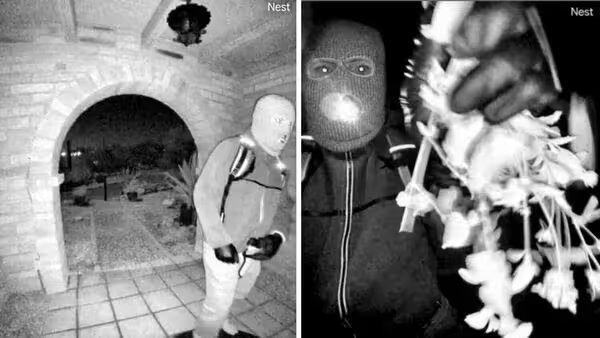
The FBI recovered Google Nest footage that shouldn’t have existed. Here’s what that means for every smart camera owner who thought their data was private.
On February 1, 2026, 84-year-old Nancy Guthrie — the mother of NBC’s “Today” co-anchor Savannah Guthrie — was abducted from her home in Tucson, Arizona. When investigators turned to the Google Nest doorbell camera mounted near her front door, they hit what seemed like a dead end. The camera had been disconnected at 1:47 a.m. Guthrie didn’t have an active Nest Aware subscription. According to everything law enforcement and the public understood about how these devices work, the footage was gone.
Then, ten days later, the FBI dropped a bombshell.
FBI Director Kash Patel announced that investigators had recovered images and video from the camera after all — footage showing a masked, armed individual tampering with the camera the morning Guthrie disappeared. The source? What Patel described as “residual data located in backend systems.”
That phrase — residual data located in backend systems — should make every smart home camera owner stop and think.
What Google Says Should Have Happened
Google’s official documentation is clear: without a subscription, Nest cameras provide roughly three hours of event-based video previews. After that window closes, clips are “deleted.” To access recordings beyond that limit, you need a Google Home Premium Standard or Advanced subscription. Standard provides 30 days of event-based history. Advanced records 24/7 and stores footage for up to 60 days.
Nancy Guthrie had none of these subscriptions. By every metric Google presents to its customers, the footage from her doorbell camera should have been inaccessible — possibly non-existent — within hours of being recorded.
But it wasn’t.
How “Deleted” Actually Works in the Cloud
Here’s what most consumers don’t understand about cloud-based data deletion, and it’s something we’ve been warning about in the IoT security space for years (we explored the broader implications of always-on home devices in our earlier piece, Your Smart Doorbell Is Watching More Than You Think).
When you “delete” a file in a cloud system — or when a system automatically purges data after a retention window expires — the file isn’t typically wiped from existence. The storage block that held the data is simply flagged as available for reuse. Think of it like tearing a page number out of a book’s table of contents. The page is still in the book. It’s just no longer indexed. The actual data persists on disk until something else needs that space and overwrites it.
This is true across virtually every major cloud infrastructure provider. Google Cloud Storage, for example, has a feature called “soft delete” that retains deleted objects in a recoverable state for a default of seven days — and this can be extended up to 90 days. Google’s own data deletion documentation acknowledges that backup storage systems can retain copies of data for up to six months after deletion.
Now layer in the reality of modern cloud architecture. Your Nest camera doesn’t just send video to one server. As cybersecurity experts have noted, these video files traverse “layers and layers” of servers, potentially distributed across data centers worldwide. Each processing node, each caching layer, each backup system represents another place where data fragments can linger. Even after the primary copy is marked for deletion, residual copies can persist across development pipelines, logging systems, analytics platforms, and disaster recovery backups.
Adam Malone, a former FBI special agent who now works as a cyber crisis expert at Kroll, suggested that Google’s engineers likely examined their entire development pipeline asking whether any of their systems processed or temporarily stored data from the camera — and found fragments that could be reassembled.
 Secure IoT HouseSecure IoT House
The Consent Problem No One Is Talking About
This is where the story shifts from a fascinating forensic achievement to a deeply uncomfortable privacy question.
If you own a Nest camera and don’t pay for a subscription, what are you consenting to? You might reasonably believe you’re saying: I want a basic camera that shows me live video, but I don’t want recordings stored in the cloud. You’re specifically not opting in to cloud storage by declining to pay for it.
But Google’s own privacy policy — the document most users scroll past without reading — tells a different story. It states that video can be captured even when a device appears offline: “That means you may not see a visual indicator when your camera is sending the video footage to our servers.”
Read that again. Your camera may be sending footage to Google’s servers without a visible indication that it’s doing so, even if you never paid a dime for cloud storage.
And once that data reaches Google’s infrastructure, it enters a complex ecosystem of servers, backups, and processing pipelines where “deletion” is a process, not an event. A process that, as the Guthrie case demonstrates, can be reversed with sufficient motivation and a federal warrant.
The Legal Framework Is Full of Holes
Under the Stored Communications Act, law enforcement generally needs a warrant to obtain stored electronic communications, including cloud-stored video. Google’s own transparency report states that the company reviews requests for scope and legality before handing over data.
But there are significant gaps in these protections.
Michelle Dahl, executive director of the Surveillance Technology Oversight Project, raised a critical point: some user agreements specify that data collected by cameras belongs to the camera company, not the camera owner. In those cases, companies can share footage with law enforcement at their own discretion — sometimes without even notifying the user.
There’s also the “emergency exception.” Amazon demonstrated this with its Ring cameras in 2022 when it was revealed that the company had provided police with Ring doorbell footage 11 times in a single year without user consent or a warrant, citing “emergency” provisions involving “imminent danger of death or serious physical injury.” Amazon — and by extension, any company with similar terms — gets to unilaterally decide what constitutes an emergency.
The Guthrie case didn’t apparently rely on an emergency exception; the FBI obtained warrants. But the underlying capability is the same: data that users believed was gone, or never stored at all, was retrievable from company systems.
As Pima County Sheriff Chris Nanos somewhat remarkably stated during the investigation: “I can’t even tell you how many different corporate America, Google, Apple, Meta, all these companies have said, ‘Whatever you need, Sheriff, they’re there.’”
 Secure IoT HouseSecure IoT House
The Dual-Edged Sword
Let’s acknowledge the obvious: in the Nancy Guthrie case, the recovery of this footage was enormously valuable. The video showed an armed, masked individual approaching her front door, and the images generated over 18,000 tips to investigators. For this specific case, the existence of recoverable “ghost data” on Google’s servers is potentially the difference between solving and not solving an abduction.
But here’s the thing about surveillance infrastructure: it doesn’t come with a moral compass. The same capability that helps the FBI find a kidnapping suspect also means that anyone with legal leverage — or a company willing to comply with broad requests — can potentially access video from inside and around your home that you had every reason to believe was never stored.
As Dahl put it: “I think the public has gotten too comfortable with surveillance cameras in not only public spaces, but also their private homes, without thinking about the consequences of where that data ends up.”
What Smart Camera Owners Should Do Right Now
1. Assume everything is recorded and stored. Regardless of your subscription status, treat your smart camera as if every frame it captures is being transmitted to and stored on remote servers. Because it very likely is, at least temporarily.
2. Read the actual privacy policy. Not the marketing page. Not the setup wizard. The full privacy policy and terms of service. Look specifically for language about data retention, law enforcement cooperation, and emergency disclosures.
3. Understand the difference between “event-based” recording and “always recording.” Even without a subscription, many cameras record events (motion detection, person detection) and transmit that data to the cloud for processing. The “no subscription” tier doesn’t mean “no cloud interaction.”
4. Consider local-storage alternatives. If you’re serious about keeping footage under your control, look at camera systems that store video locally — on microSD cards or a local NVR (network video recorder) — rather than routing everything through a third-party cloud. Companies like Eufy have marketed themselves specifically on this local-storage approach, though they’ve had their own controversies around undisclosed cloud uploads.
5. Treat camera placement as a privacy decision, not just a security decision. Every camera you install is a potential data source for anyone who can access the backend — whether through a warrant, a corporate decision, a data breach, or an insider threat.
6. Advocate for stronger data minimization laws. Organizations like the Electronic Frontier Foundation and the ACLU have been pushing for explicit retention limits and true deletion requirements for connected devices. Until legislation catches up with the technology, the gap between what consumers expect and what actually happens with their data will continue to grow.
The Bigger Picture
The Nancy Guthrie case has inadvertently pulled back the curtain on something cybersecurity professionals have known for years: in the cloud era, deletion is an aspiration, not a guarantee. Data persists in backups, caches, logs, processing pipelines, and disaster recovery systems long after the primary copy is “deleted.”
For consumers, the implications extend far beyond smart cameras. Every cloud-connected device in your home — your smart speaker, your thermostat, your robot vacuum with its detailed floor map of your house — is generating data that flows through similar infrastructure with similar retention characteristics.
The question isn’t whether your data exists on someone else’s servers. It does. The question is who can access it, under what circumstances, and whether you had any meaningful say in the matter.
Based on what we just learned from Tucson, the answer to that last question is increasingly: no.
This article is part of our ongoing coverage of smart home privacy and security at SecureIoT.house. For more on the privacy implications of always-on home devices, read our previous deep dive: Your Smart Doorbell Is Watching More Than You Think: The Privacy Nightmare of Always-On Home Devices.