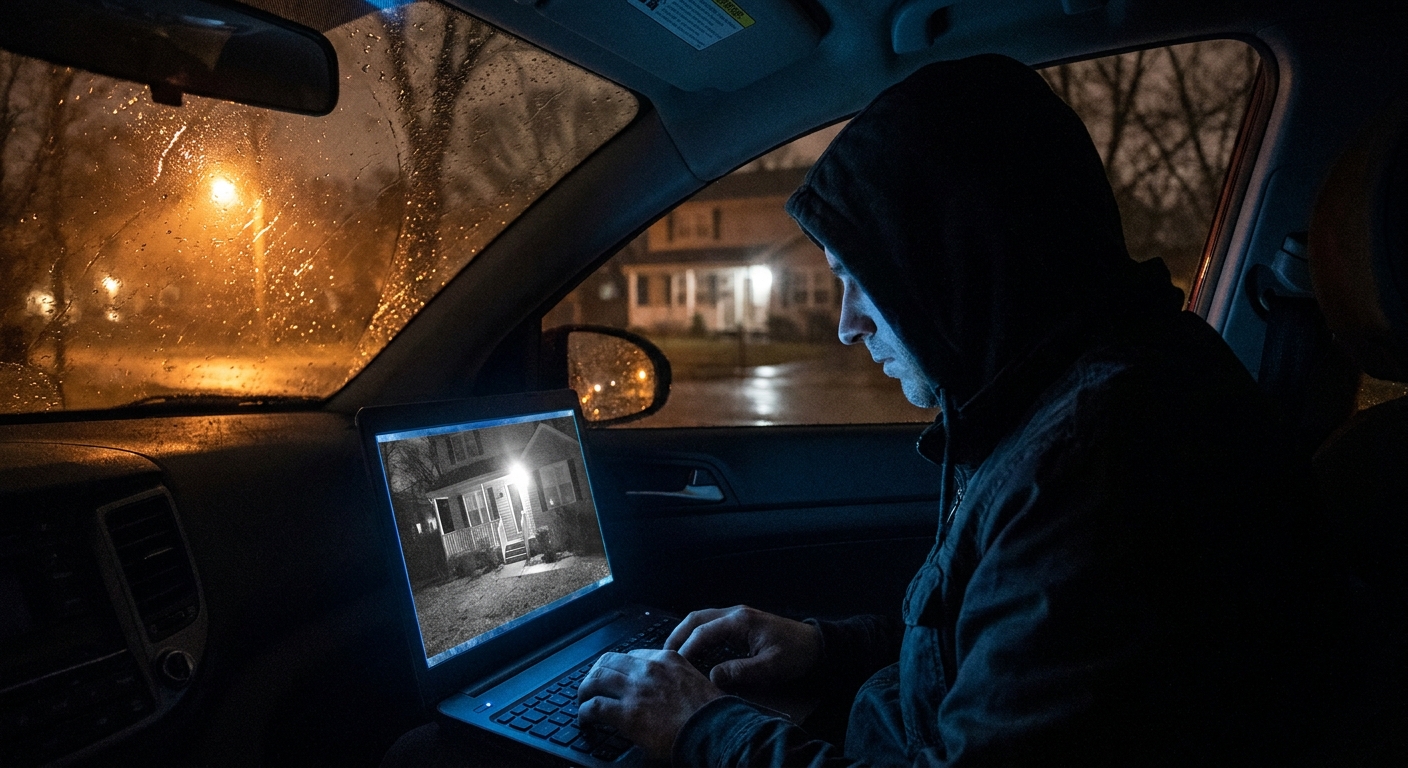
The smart devices you installed to make your home safer may be handing criminals a detailed blueprint of your life.
In early April 2026, law enforcement officials and security researchers raised alarms about a growing pattern: criminals are learning to exploit vulnerabilities in consumer smart home devices — not to steal data, but to facilitate physical break-ins. The attack profile is disturbing in its sophistication: surveilling homes through compromised cameras, unlocking smart locks remotely, and opening connected garage doors through older protocols that were never designed to resist attack.
These aren’t theoretical threats. Investigators have documented specific cases.
The Surveillance Case
In one documented case highlighted by law enforcement, a burglar hacked into a homeowner’s smart doorbell camera feed. He watched the family’s daily routine for three weeks — noting when they left for work, when they returned, when the house was empty for extended periods. When he finally struck, he timed the entry perfectly.
The homeowner never received an alert. The camera never showed signs of tampering. From the outside, the security system appeared to be working perfectly.
How? The camera was running firmware with a known authentication vulnerability — a flaw that had been publicly disclosed and patched, but never applied to the device in the field. The attacker didn’t need to be on the same network or even nearby. The camera was accessible from the internet, and the exploit was automated.
The Three Attack Surfaces Being Exploited
1. Smart Doorbell and Security Cameras
Smart cameras represent the richest surveillance opportunity for an attacker. A compromised camera provides:
- Real-time video feed of activity inside and outside the home
- Historical footage showing routines, visitor patterns, and schedule predictability
- Audio of conversations near the device
- Motion alerts that can be reprogrammed to notify the attacker instead of (or in addition to) the homeowner
The most common exploitation vectors:
Default credentials: Many cameras ship with manufacturer-set usernames and passwords that are publicly documented. Consumers who never change them remain permanently vulnerable to anyone who looks up the default.
Unpatched firmware vulnerabilities: Security researchers regularly discover authentication bypass flaws in camera firmware. Manufacturers release patches; devices in the field rarely receive them.
Exposed web interfaces: Cameras with cloud-connected management portals that are directly internet-accessible without 2FA provide a direct attack path.
Weak cloud backend security: In some cases, the camera itself is secure, but the cloud platform it connects to has vulnerabilities that allow attackers to access feeds without device credentials.
2. Smart Locks
Smart locks have introduced a category of vulnerability that didn’t exist with mechanical locks: remote exploitation.
Security researchers have demonstrated multiple attack scenarios against popular smart lock brands:
Bluetooth low energy (BLE) replay attacks: Some smart locks transmit authentication tokens over BLE that can be captured and replayed by an attacker within Bluetooth range.
Software vulnerability exploitation: Critical authentication flaws in smart lock firmware or associated apps have allowed researchers to unlock devices remotely over Wi-Fi without valid credentials.
Cloud account compromise: If the cloud account associated with a smart lock (typically an email/password login) is compromised through credential stuffing or phishing, the attacker has remote unlock capability on every door where that lock is installed.
Hub-level vulnerabilities: Smart home hubs that integrate locks (like Home Assistant, SmartThings, or similar) can become a single point of failure if compromised.
One documented demonstration showed a security researcher remotely unlocking a popular smart lock model from across the country by exploiting a software vulnerability in the lock’s Wi-Fi module — no physical proximity required.
3. Smart Garage Door Openers
Smart garage door openers represent an often-overlooked attack surface because homeowners tend to focus security attention on front doors and windows.
The exploitation vectors are specific:
Legacy frequency hopping: Older “smart” garage door systems — those marketed as smart simply because they can be triggered via app — often still use rolling-code RF systems that can be captured and replayed with inexpensive hardware.
Weak authentication in web APIs: Many smart garage door openers expose web APIs for remote operation. These APIs, if they use weak authentication or contain logic flaws, can be exploited to trigger door opens remotely.
UPnP exposure: Garage door controller hubs that rely on UPnP for network access may inadvertently expose themselves to the internet through automatic port forwarding on the home router.
The physical consequence: An open garage door is not just a garage vulnerability. In most homes, the door from the garage to the interior of the house is less secure than the front door — often unlocked, sometimes hollow-core, frequently without a deadbolt. Criminals know this.
The Numbers Behind the Risk
| Metric | Figure |
|---|---|
| Average IoT cyberattack attempts per household per day (2026) | 29 |
| IoT devices globally running outdated firmware with known exploitable flaws | 33% |
| IoT devices collecting personally identifiable information | 62% |
| Homes with at least one internet-connected security camera | ~45% in US |
| Smart lock market growth 2025–2030 | ~15% CAGR |
The attack attempts are relentless. The devices are proliferating. And the firmware is going unpatched.
Why “Smart” Doesn’t Mean “Secure”
The home security industry has a credibility problem: it sells the feeling of security while sometimes reducing actual security.
A mechanical deadbolt with a bump-resistant pin tumbler is extremely difficult to defeat without physical skill, time, and noticeable effort. A smart lock with an exploitable firmware vulnerability can be opened instantaneously from anywhere on earth with no physical presence and no evidence of entry.
This doesn’t mean smart locks are always worse than mechanical locks — properly implemented, with up-to-date firmware, strong account security, and 2FA, a smart lock can be highly secure. But the as-shipped, never-updated, default-password state of most deployed smart home devices creates real attack surface.
The same analysis applies to cameras, garage openers, and any other internet-connected device given physical access to your home.
What To Do: A Practical Hardening Checklist
Smart Cameras:
- Change the default username and password to something unique and strong
- Enable two-factor authentication on the associated cloud account
- Check for and apply firmware updates (set automatic updates if supported)
- Disable direct internet access to the camera’s web interface if you only need cloud access
- Put cameras on a separate IoT network segment, isolated from computers and phones
- Review which cloud services have access to your camera feeds and revoke unnecessary permissions
Smart Locks:
- Enable two-factor authentication on the lock’s associated app/account
- Use a unique, strong password for the cloud account — not reused from anywhere else
- Keep lock firmware updated (check the manufacturer app regularly)
- Consider keeping a physical key backup for the same door
- Review access logs periodically for unexpected unlock events
- Disable any remote access features you don’t actively use
Smart Garage Door Openers:
- Update the controller firmware
- Enable notifications for all open/close events
- Install a physical lock or deadbolt on the interior garage-to-house door
- Consider a door sensor as a secondary alert layer
- Disable UPnP on your router to prevent inadvertent internet exposure
General Smart Home Security:
- Create a separate Wi-Fi network (IoT VLAN or guest network) for all smart home devices
- Never connect smart home devices to the same network as your computers and phones
- Register all devices with manufacturers to receive security update notifications
- Set a calendar reminder every 6 months to check for firmware updates on all devices
The Bottom Line
Smart home devices aren’t inherently less secure than traditional alternatives — but they require active, ongoing maintenance that most consumers don’t know they need to provide. A doorbell camera that was secure when installed two years ago may be completely vulnerable today because of a firmware flaw discovered last month.
Treat your smart home devices the way you’d treat your laptop: update them regularly, use strong unique credentials, enable two-factor authentication, and segment them from your most sensitive devices. The convenience is real. So is the risk.