The US energy grid is the backbone of modern civilization. It powers hospitals keeping patients alive, AI data centers processing the workloads of the next economic era, water treatment plants, and the smart buildings and industrial facilities where your readers work every day. For decades, that backbone has operated with aging control systems, minimal security budgets, and a patchwork of voluntary guidance that threat actors learned to navigate long before defenders caught up.
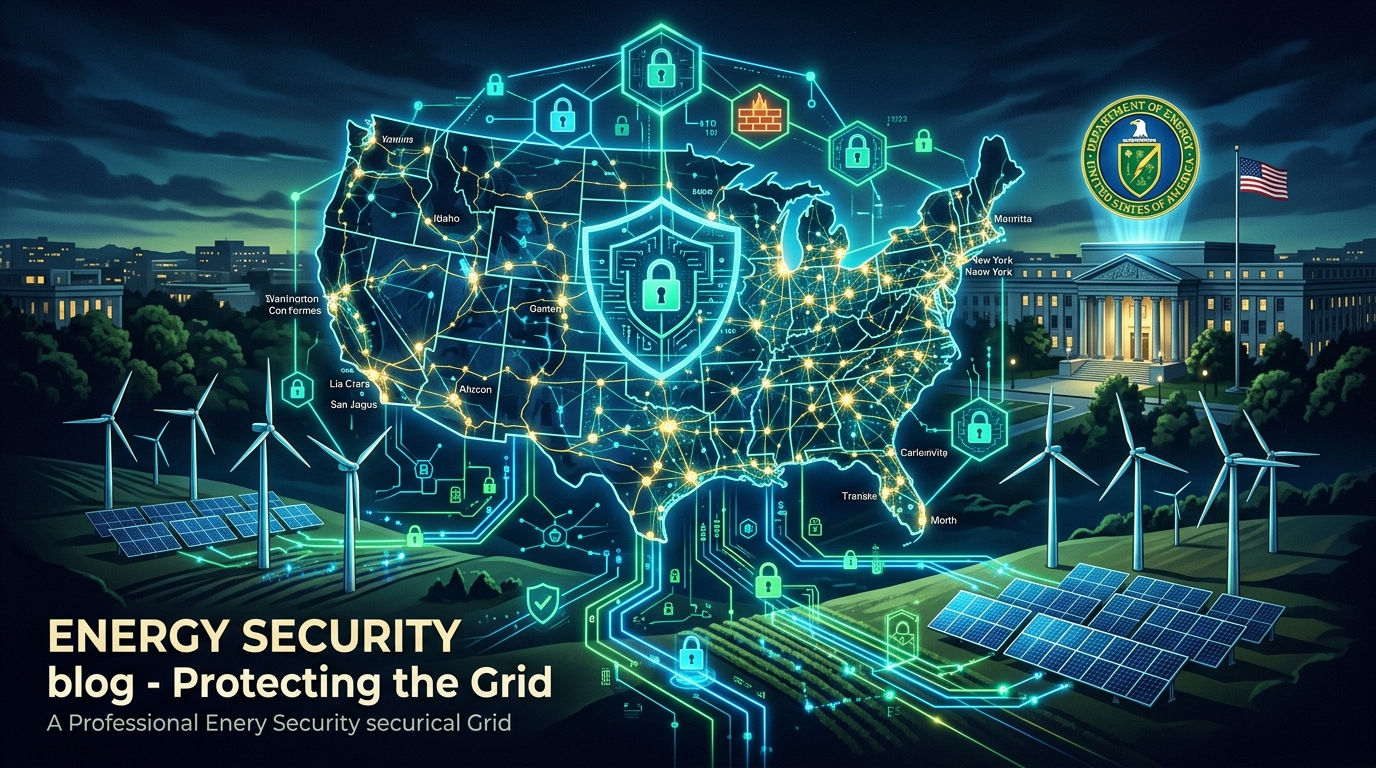
On March 23, 2026, the Department of Energy changed that — at least on paper. DOE’s Office of Cybersecurity, Energy Security and Emergency Response (CESER) published its first-ever formal, comprehensive cybersecurity strategy: the CESER Strategic Plan Fiscal Years 2026 to 2030. It is not a wish list. It is a five-year roadmap with defined priorities, measurable outcomes, and a clearly stated federal coordination role — and if you work in OT/ICS security, utilities, building automation, or industrial IoT, it directly shapes the compliance and threat landscape you’re operating in right now.
Why the Grid Is America’s Most Critical — and Most Targeted — Infrastructure
The US electrical grid is not one system. It’s thousands of interconnected systems: generation plants, transmission networks, distribution substations, smart meters, building energy management systems (BEMS), and industrial control systems (ICS) that were often designed before the internet existed and were never meant to be online.
That design reality creates a unique vulnerability profile. Operational technology (OT) — the PLCs, RTUs, DCS, and SCADA systems that control physical processes — runs on protocols like Modbus, DNP3, and IEC 61850 that have no built-in authentication. Many OT systems can’t be patched without shutting down operations. Some run on hardware with five-year lifecycles that became ten or twenty years because nobody wanted to touch a working system. And increasingly, those systems are networked — often directly to IT infrastructure, cloud services, or the internet — because operational efficiency and remote monitoring demanded it.
The consequences of a successful attack aren’t a data breach or a ransomware notice on a workstation. They’re blackouts. Cascading failures. Physical damage to transformers that take 18 months to replace. The 2015 and 2016 Ukraine grid attacks — attributed to Russia’s Sandworm group — proved this wasn’t theoretical: attackers used BlackEnergy and Industroyer malware to kill power for hundreds of thousands of civilians in the dead of winter, the first confirmed cyberattacks to cause physical power outages. The Colonial Pipeline ransomware attack in 2021 didn’t even touch OT systems directly — but the operator’s decision to shut down pipelines out of caution triggered fuel shortages across the Eastern seaboard. That’s how interconnected and fragile this infrastructure is.
Now layer on a new pressure: AI-driven electricity demand. Hyperscale data centers training large language models and running inference workloads are projected to dramatically increase grid load through 2030. More load means more distributed generation, more grid-edge devices, more smart inverters, more connected industrial equipment — and a dramatically expanded attack surface at every layer from substation to socket.
What CESER’s Strategic Plan Actually Says
The 2026-2030 plan is organized around three strategic priorities. Here’s what each one means in practice.
Priority 1: Develop Advanced Cybersecurity Technologies for Energy Systems
This pillar accelerates research and deployment of security tools specifically designed for OT environments — not IT tools retrofitted to energy systems. The emphasis is on embedding security into system design from the outset, a principle known as secure-by-design, rather than bolting on controls after deployment.
CESER is specifically driving forward AI-FORTS (AI-enabled capabilities for the Future of OT and ICS Security), an initiative designed to use artificial intelligence for threat detection, maintaining operations during incidents, and improving supply chain oversight. The logic is sound: with only 66 staff coordinating a national mission, automation and AI-assisted analysis are the only realistic paths to scale.
The plan also commits to developing energy-specific threat intelligence and sharing it with industry partners in a timely, actionable format — moving away from generic cybersecurity advisories toward guidance that an energy OT engineer can actually implement.
Priority 2: Harden Infrastructure Against Cyber and Physical Threats
This is the broadest pillar and the one with the most direct implications for utilities and building operators. CESER is explicitly addressing the full security stack: generation, transmission, distribution, and the supply chains that support all of them.
The supply chain focus is significant. Officials have warned that adversaries are targeting the ecosystem of vendors, managed service providers, and equipment manufacturers that underpin energy operations. A single compromised MSP with remote monitoring tools installed across OT networks can provide simultaneous access to dozens of industrial clients — a pattern that mirrors exactly how threat actors like Volt Typhoon have operated.
The hardening pillar also encompasses physical security and counter-UAS (drone) capabilities — expanding CESER’s mission scope well beyond pure cybersecurity. Drone-based attacks on substations and transmission infrastructure are a recognized and growing threat vector.
Priority 3: Improve Incident Response and Recovery Speed
The third pillar addresses what happens when — not if — a significant incident occurs. CESER is formally positioned as the lead US government coordinating agency for the energy sector during emergencies, responsible for preparedness and response to natural disasters, physical attacks, and cyber incidents.
The plan prioritizes closing the gaps in coordination, visibility, and resilience exposed by recent high-profile incidents. This includes accelerating recovery from OT-impacting events where operators may lack the forensic visibility to understand what happened, let alone how to safely restore operations without re-triggering an attacker’s persistence mechanisms.
What’s Genuinely New Here
DOE has published cybersecurity guidance before. What makes this different?
First, it’s the first formal strategic document that defines CESER’s mission, goals, and measurable outcomes in a single place. Previous efforts were fragmented across programs, advisories, and guidance documents. This plan creates accountability: CESER now has stated objectives it can be measured against.
Second, it explicitly sharpens the federal coordination role. As Louis Eichenbaum, former CISO for the Department of Interior and now federal CTO at ColorTokens, put it: the plan “reinforces DOE as the sector risk manager responsible for resilience, response and coordination” and “meaningfully sharpens the federal approach to securing critical energy infrastructure.” That clarity matters when an incident happens and multiple agencies are competing for coordination authority.
Third, the OT-specific technology focus is real. Generic cybersecurity frameworks from NIST or CISA are useful but don’t address the specific constraints of ICS environments — real-time operating requirements, legacy protocols, air-gap assumptions that no longer hold, and the physical consequence model where a false positive can trigger an outage just as surely as a successful attack.
The honest asterisk: the plan’s ambitions are constrained by budget and staffing realities. CESER requested $150 million for FY2026 — down from $200 million in each of the prior two fiscal years — even as its mission has expanded. Collin Hogue-Spears of Black Duck noted the core execution problem bluntly: “CESER is asking 66 people to coordinate across more mission areas than 96 people managed before.” The plan also assumes meaningful partnership with CISA, which lost significant staff in 2025. These aren’t reasons to dismiss the strategy, but they’re real constraints on execution speed.
The AI Demand Problem: More Electricity, More Attack Surface
The same AI revolution driving demand for DOE’s cybersecurity roadmap is also accelerating the threat landscape. Every new data center requires new grid connections. Every new grid connection introduces smart inverters, energy management controllers, and IoT-enabled distribution equipment. Every new piece of connected equipment is a potential entry point.
The US grid is already undergoing its fastest expansion in decades to serve AI compute demand — and that expansion is outpacing the security practices designed to govern it. New grid-edge devices are being deployed at scale, often with default credentials, unpatched firmware, and no OT security review. The attack surface is growing faster than defenses can keep up.
CESER’s AI-FORTS initiative implicitly acknowledges this: you can’t manually monitor thousands of new OT endpoints across a national grid. You need automated detection. But as analysts have noted, automated defensive systems in OT environments must operate with extreme precision — a false positive that trips a circuit breaker has consequences equivalent to a successful attack.
Who’s Targeting the Grid: China, Russia, and Iran
The threat actor landscape is well-documented and actively worsening.
China’s Volt Typhoon (tracked by Dragos as Voltzite) is the most strategically alarming. Rather than causing immediate disruption, Volt Typhoon conducts long-duration pre-positioning — dwelling in critical infrastructure networks to collect OT data and map systems for potential future action. SecurityWeek reported in 2025 that Volt Typhoon hackers had dwelled in a US electric grid environment for 300 days. This isn’t espionage for intelligence gathering. The consensus assessment from CISA, NSA, and the FBI is that China is pre-positioning for potential disruption during a future conflict — including a Taiwan contingency.
Russia’s Sandworm demonstrated operational capability against grid infrastructure in Ukraine and has the tools, intent, and history to attempt similar operations against Western targets. The Industroyer2 malware deployed against Ukrainian substations in 2022 confirmed that Russia continues to develop and refine grid-specific attack capabilities.
Iran has shown increasing sophistication in targeting ICS/OT environments, including water systems and industrial controllers. CloudSEK’s recent 2026 threat landscape assessment highlighted specific Iranian tactics targeting SCADA engineers and control room operators through spearphishing impersonating equipment vendors — a direct supply chain social engineering approach that bypasses most network-level defenses.
The common thread across all three threat actors: they’re not just targeting enterprise IT. They’re targeting the OT layer specifically, because that’s where physical consequences live.
What Utilities, Contractors, and Building Operators Should Do Right Now
DOE’s plan doesn’t impose new mandatory regulations outside emergency scenarios, but it signals clearly where the federal focus is heading. Here’s how to get ahead of it.
✅ What to Do Now — Action Checklist
1. Conduct an OT asset inventory. You cannot protect what you cannot see. Many utilities and building operators have incomplete visibility into what’s connected to their OT networks — especially after recent expansions. Start with a passive network discovery tool appropriate for OT environments (Dragos Platform, Claroty, Nozomi Networks).
2. Enforce network segmentation between IT and OT. The IT/OT convergence trend is real and operationally necessary, but it requires deliberate segmentation — not a flat network where a phished IT user can reach PLCs. Implement a demilitarized zone (DMZ) architecture for any data flows between IT and OT.
3. Implement multi-factor authentication everywhere you can. James Maude of BeyondTrust noted that “even basic measures such as enforcing multifactor authentication and limiting privileged access can significantly reduce risk without requiring major new investments.” Start here. Remote access into OT environments without MFA is an open door.
4. Audit privileged access and remote access accounts. Vendors, contractors, and MSPs with persistent remote access credentials to your OT environment are a top attack vector. Review every account with OT access and eliminate standing privileges where possible.
5. Review your supply chain for vendor security posture. CESER’s hardening pillar explicitly flags supply chain risk. Know which of your technology vendors have access to your systems, and start asking them for security attestations.
6. Test your incident response plan against an OT-specific scenario. Most IR plans are written for IT environments. Run a tabletop exercise that simulates a SCADA compromise or loss of view in a substation. Identify your gaps before an attacker does.
7. Engage with CESER programs — especially if you’re a smaller utility. The Rural and Municipal Utility Cybersecurity (RMUC) initiative offers technical assistance and grant funding specifically for smaller operators who lack dedicated security staff. Don’t leave federal resources on the table.
The IoT and Smart Building Connection
If you work in building automation, smart building security, or industrial IoT, this plan is not just a utility story. Building energy management systems, smart meters, connected HVAC controllers, and grid-interactive building equipment are part of the grid attack surface. A compromised building management system connected to a campus microgrid or demand response program is an OT target.
CESER’s scope covers the full energy sector — including distributed energy resources (DERs) like rooftop solar, battery storage, and EV charging infrastructure. As smart buildings increasingly participate in grid-interactive programs — curtailing loads, providing frequency regulation, selling back energy — they become nodes in the same OT network that CESER is trying to secure.
The implication is direct: the security standards being defined for energy OT systems will eventually reach building automation systems. Getting ahead of that curve now means being compliant later, and more importantly, being secure now.
Conclusion: This Is Not Just Government Paperwork
It would be easy to read a federal strategic plan and file it under “nice to have.” Don’t.
The CESER 2026-2030 plan represents a genuine shift in federal posture — from advisory to operational, from fragmented guidance to a coordinated national strategy with a named lead agency and stated measurable outcomes. It comes at a moment when the threat landscape is at its most serious, grid attack surface is expanding faster than ever, and the consequences of failure are measured not in leaked data but in dark cities and damaged infrastructure.
“The real shift is toward a more action-oriented, resilience-first posture,” said Louis Eichenbaum of ColorTokens. That posture will shape what DOE expects of utilities, what auditors look for in critical infrastructure assessments, and what courts examine when an incident results in harm.
The five-year clock started March 23, 2026. The utilities and operators who treat this as a compliance deadline — rather than a reading assignment — will be the ones that are both secure and defensible when the next major grid incident occurs. Because the threat actors aren’t waiting for the roadmap to be executed. They’re already inside.
Sources: CESER Strategic Plan FY2026-2030 (DOE/CESER); GovInfoSecurity, March 23, 2026; Industrial Cyber, March 2026; SecurityWeek, March 2025; CloudSEK ICS/OT Threat Assessment 2026; CISA China Threat Overview.